Commercial Service

Commercial Security Maintenance, Fire Alarm Inspections, and Monitoring Services in DFW

Security maintenance contracts, fire alarm inspections, and central station monitoring for DFW commercial buildings. One contract, one monthly fee, no surprise capital outlay.

Specialist reviewing building plans at a commercial project site
What I handle

One contract for monitoring, inspection, and maintenance

A security maintenance contract keeps your physical security systems tested, documented, and current, so cameras stay aligned, access credentials stay clean, and firmware doesn’t fall behind. From there, fire alarm monitoring connects your building’s alarm system to a UL-listed central station that dispatches fire and emergency responders when an alarm triggers. This page is for facilities managers, property managers, and SMB owners in DFW who are evaluating managed physical security services and fire alarm monitoring for their commercial buildings. If you landed here looking for IT cybersecurity monitoring or managed security services for your network infrastructure, this is not that. I work exclusively in physical security: access control, fire alarm systems, and the monitoring and maintenance contracts that keep them compliant and operational.

A commercial alarm monitoring subscription bundles monitoring, inspection, and maintenance into a single fixed monthly fee instead of requiring a large upfront capital investment. The subscription model converts what is typically an unpredictable capital expenditure into a predictable operating expense. For DFW facilities managers dealing with aging systems, contract renewals, or failed inspections, that distinction matters.

  • UL-Listed Monitoring

    24/7 central-station monitoring certified to UL 827, recognized by insurers and AHJs.

  • NFPA 72 Inspection Included

    Annual and quarterly testing scheduled and documented by me, not left on your calendar.

  • Managed Access Control

    Credential changes, event-log review, and alerts folded into the same agreement.

  • One Contract, One Fee

    Monitoring, inspection, and maintenance on a single invoice with one point of contact.

  • OpEx, Not CapEx

    A predictable monthly cost instead of an $80K to $300K capital event.

  • Hardware Refresh Covered

    Equipment stays current under the agreement, so you do not carry the aging risk.

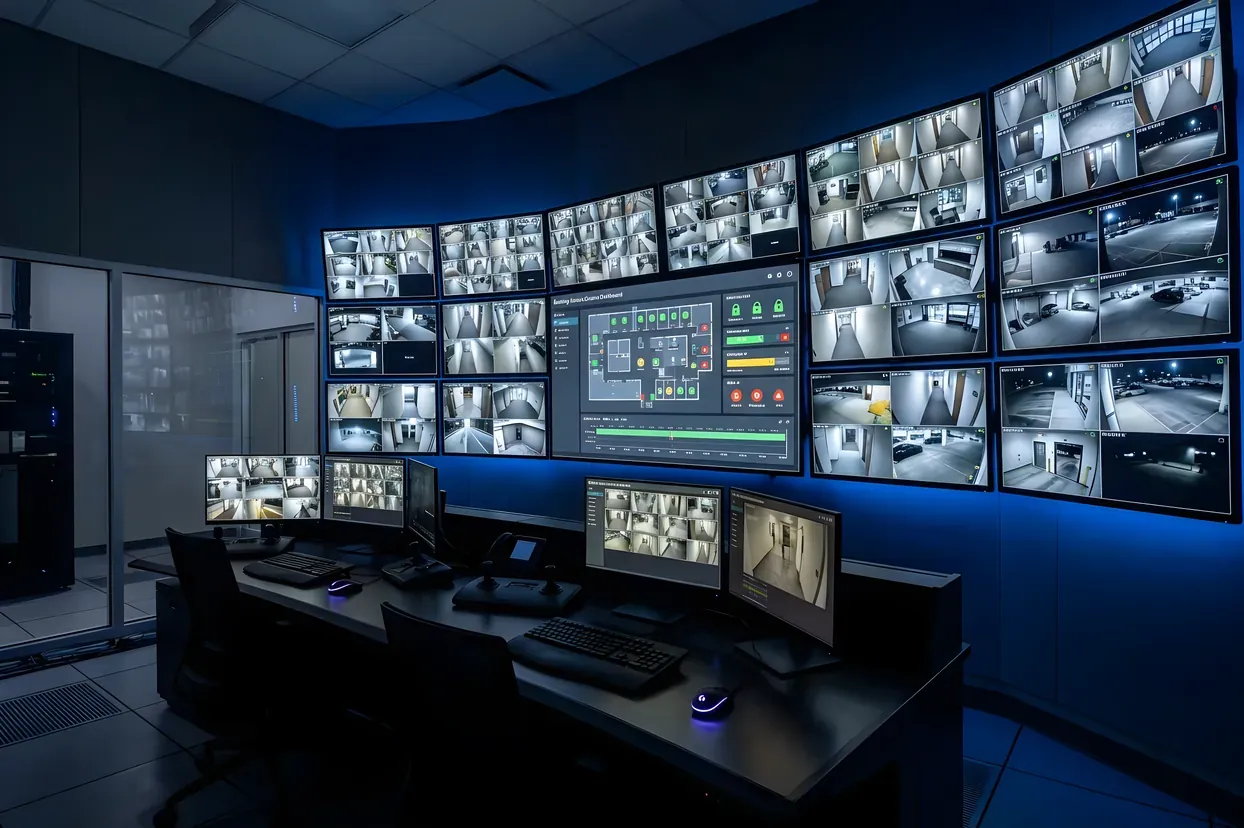
Security monitoring room with surveillance feeds and an access-control dashboard

What is actually covered, and how the money works

Managed physical security means one provider takes responsibility for the ongoing monitoring, testing, and maintenance of your systems under a single agreement. Each area below opens for the full detail, including the financial comparison between owning the equipment and subscribing to it.

What Fire Alarm Monitoring Service Actually Includes

Fire alarm monitoring service routes alarm signals from your building’s fire alarm control unit (FACU) to a UL-listed central monitoring station. The UL listing matters: Underwriters Laboratories certifies central stations to the UL 827 standard, which requires redundant power supplies, backup communications, trained operators, and documented response protocols. A UL-listed station is not a call center. It is a specialized facility built to receive and act on alarm signals from commercial buildings around the clock.

How signals reach the station depends on the type of digital communicator installed at your building. A DACT (digital alarm communicator transmitter) sends signals over phone lines, while IP and cellular communicators send signals over internet or cellular networks. Your local Authority Having Jurisdiction (AHJ), which is the fire marshal or building department with oversight authority in your city, may specify which connection type is acceptable. Dallas and Fort Worth each have their own AHJ requirements, and those requirements may go beyond the minimum set by the national codes.

NFPA 72, the National Fire Alarm and Signaling Code, establishes the federal-level framework for commercial fire alarm monitoring in Chapter 26. A compliant monitoring setup receives three types of signals from your building: fire alarm signals (an initiating device has detected smoke, heat, or manual pull), supervisory signals (a system condition is abnormal, such as a sprinkler valve being closed), and trouble signals (a component is reporting a fault). Each signal type triggers a different response sequence at the central station. A fire alarm signal results in immediate dispatch of the fire department and notification of the building contact. A trouble signal triggers a notification to the building to investigate.

Not all monitoring is equal. A UL-listed central station has documented response time standards, trained operators who understand alarm signal types, and a verified infrastructure. Non-listed stations may answer the phone, but they do not carry the same certification requirements. For most commercial buildings in DFW, your insurer and your AHJ will want UL-listed monitoring confirmed on your service documentation.

Managed Fire Alarm Services: Monitoring, Inspection, and Maintenance in One Contract

Most facilities managers are dealing with a fragmentation problem they have accepted as normal. The monitoring contract goes to one company. The annual NFPA 72 inspection goes to a second company. When something breaks, a third company is on the phone. Three invoices. Three scheduling relationships. Three points of accountability when something goes wrong, and three separate sets of documentation to pull together before an AHJ visit or an insurance audit.

Managed fire alarm services consolidates that into one contract. At the service delivery level, a managed fire alarm contract typically combines 24/7 UL-listed central station monitoring, NFPA 72-required annual inspection, quarterly and semi-annual testing, covered parts and labor for listed components, and inspection documentation filed for your AHJ and insurer. The inspection piece alone changes the dynamic. Under a managed contract, inspection scheduling is the provider’s responsibility, not yours. You do not miss an inspection because it fell off the calendar during a busy quarter.

NFPA 72 sets the minimum inspection and testing frequency as annual for most commercial occupancies, with more frequent requirements for high-risk occupancy types. A managed fire alarm services contract should specify the inspection schedule in writing and include the delivery of inspection certificates and test records at each cycle. Those records are what you hand to the AHJ when they show up, and what your insurer expects to see when you renew your policy.

For a concrete picture: a 40,000 square foot office building with 200 initiating devices and the corresponding notification appliances is a significant inspection job. Under a fragmented vendor setup, you coordinate the inspection company, verify they completed testing on all devices, chase down the documentation, and file it yourself. Under a managed fire alarm services contract, that coordination is built into what you are paying for. If you want a detailed breakdown of what a commercial fire alarm inspection covers in DFW, I walk through the full scope on my fire alarm inspection service page.

Managed Access Control as Part of the Bundle

Once fire alarm monitoring is under a managed contract, access control is the logical next service to bring into the same agreement. Managing them separately, with different service providers, different billing cycles, and different contacts, adds administrative overhead for property managers who are already running lean.

Managed access control covers the day-to-day operational management of your building’s access system in addition to monitoring. That includes:

  • Credential management: adding and removing users as employees join or leave
  • Door event log review: monitoring for after-hours access, failed attempts, and anomalies
  • Alert monitoring: notifications for forced door events or credential failures outside normal hours
  • System health monitoring: proactive identification of hardware issues before they cause access failures

For DFW property managers overseeing multi-tenant commercial buildings, the case for bundling is straightforward. One invoice. One service agreement. One contact to call when something is not working. And one SLA covering response times across both systems.

Video surveillance integration is a further optional bundle layer for buildings where camera coverage and access control work together. For the full breakdown of commercial access control system options for DFW buildings, see my managed access control services page.

What a Service Maintenance Contract Covers

A well-maintained security system is one of the most cost-effective decisions a facilities manager can make. Cameras that are regularly cleaned and calibrated last longer. Access control hardware that gets firmware updates and credential audits on a schedule catches problems before they become failures. Door hardware and locking mechanisms that are tested and adjusted annually don’t fail during an incident. Beyond reliability, a structured maintenance contract gives you documented equipment condition history, which is one of the most practical tools available when you’re budgeting for future upgrades. Instead of reacting to a system failure with an unplanned capital expense, you’re looking at service reports that show you what’s aging, what’s performing, and what the replacement timeline looks like before it becomes urgent.

I spent nine years running service delivery for more than 350 commercial customers before I moved into sales, and one of the most consistent patterns I saw was customers who had signed a service maintenance agreement without fully reading what was covered and what was not. The gap between what buyers assumed was covered and what was written into the contract was the source of most of the billing disputes and the most frustrating renewal conversations. My background is in security systems first (access control, video surveillance, intrusion detection), and that’s where I can tell you with confidence what a well-structured agreement should include and what to watch for before you sign.

A well-structured service maintenance contract for a DFW commercial building includes:

  1. Security system preventative maintenance: cameras, access control hardware, intrusion detection, and firmware
  2. Documented equipment condition reports delivered after each service visit
  3. Annual NFPA 72 fire alarm inspection
  4. Quarterly fire alarm testing
  5. 24/7 UL-listed central station monitoring
  6. Priority service dispatch with a documented response time SLA (such as a 4-hour on-site response commitment)
  7. Covered parts and labor for components listed in the contract’s coverage schedule
  8. Inspection documentation and AHJ certificates delivered at each inspection cycle

What is typically excluded: vandalism damage, acts of nature, system components that have reached manufacturer end-of-life, and equipment upgrades beyond the covered scope. Those exclusions are not inherently wrong, but buyers should understand them before signing, not when they are looking at an unexpected invoice.

The renewal question is where most buyers are most exposed. If you have been on the same service maintenance agreement for three or more years and you have never reviewed the exclusion list, the response time commitments, or the monitoring connection type specified in the contract, those are the three things to audit before you auto-renew. Response time SLAs tend to erode over contract generations as providers negotiate broader language. The covered parts schedule often reflects what was installed years ago, not what your system currently runs. The Security Industry Association (SIA) provides standards guidance on what compliant physical security service agreements should address, and buyers who engage with those standards before renewal are better positioned to negotiate.

Subscription vs. Upfront Purchase: The Financial Case

The traditional model for commercial fire alarm and physical security is a capital purchase. You buy the equipment, pay for the installation, and then enter a separate monitoring contract with the provider. For a full fire alarm and access control installation in a mid-size commercial building, the upfront cost can run from $80,000 to well over $300,000 depending on building size, the condition of existing infrastructure, and the scope of devices required. For most facilities managers, that figure lands on the capital budget (CAPEX), sits in a depreciation schedule, and competes with every other capital project for approval.

The OPEX-based model changes the structure. Under a subscription model, the system, installation, monitoring, and maintenance are bundled into a fixed monthly fee. There is no capital outlay required. The monthly payment is an operating expenditure, not a depreciation schedule. For property managers who need to forecast building costs across a multi-year operating budget, converting a $200,000 capital event into a monthly line item is a genuine accounting advantage. Operating expenses hit the profit and loss statement differently than capitalized assets, and that distinction matters for how building owners and CFOs evaluate the decision.

For SMB buyers, the access question changes entirely. A 5,000 square foot medical office that cannot secure capital budget for a compliant fire alarm and access control installation can access UL-listed monitoring and managed services through a subscription model that fits within operating budget. The barrier shifts from “do we have the capital?” to “does the monthly fee work?”

Subscription contracts can also include technology refresh provisions, meaning the buyer does not carry the hardware aging risk. Rather than owning equipment that becomes obsolete over a 10-year depreciation schedule, subscription buyers remain on maintained, current hardware per the terms of their agreement. If technology refresh is a priority for your building, verify the specific terms in writing before signing.

Traditional CAPEX PurchaseSubscription Model
Upfront costHigh (equipment + installation)None or minimal
Monthly costMonitoring-only contractBundled (monitoring + inspection + maintenance)
Upgrade pathOwner’s costIncluded per contract terms
Budget predictabilityUnpredictable (break-fix)Fixed monthly fee
Who carries hardware riskOwnerProvider

On pricing: commercial alarm monitoring subscription costs depend on monitoring scope, building size, system complexity, and whether inspection and maintenance are included. A monitoring-only contract for a straightforward commercial installation runs at a different rate than a full managed services subscription. Give me a call for a specific quote for your building.

How the model works

How my subscription model works

The subscription model I offer bundles the fire alarm system, installation, UL-listed central station monitoring, NFPA 72 inspection, and ongoing maintenance under a single monthly fee. It is designed for commercial buyers who want enterprise-grade monitoring and service without the capital commitment that a traditional system purchase requires.

What that means for a DFW buyer: I work with you through the initial site assessment and system design, coordinate the installation with certified technicians, and manage the ongoing service relationship as your local DFW account executive. You are not buying a system and being handed off to a regional service team. The same person who scoped the project is your contact when something needs attention. Your monthly fee is an operating expense, covers monitoring, inspection, and maintenance under one agreement, and eliminates the unpredictable capital events that come with system ownership.

Frequently Asked Questions About Commercial Alarm Monitoring

Talk to me about monitoring before your next renewal

Most customers sign monitoring and maintenance contract renewals without reviewing what changed from the previous term. Response time commitments, exclusion lists, and monitoring connection types shift from cycle to cycle, and the time to catch those changes is before the signature, not after a service dispute. If your monitoring or service contract is coming up for renewal in the next few months, a conversation before you sign is worth the time. I serve DFW commercial buyers in English and Spanish.

Call (469) 608-7798